
Lab Result: Klow 80mg
- Lab:
- Freedom Diagnostics
- Avg. Purity:
- 99.90
- Avg. Mass:
- 79.06mg
- Result Date:
- October 24, 2026
- Search Code:
- Aven2610230138
- Lot:
- AKL-080
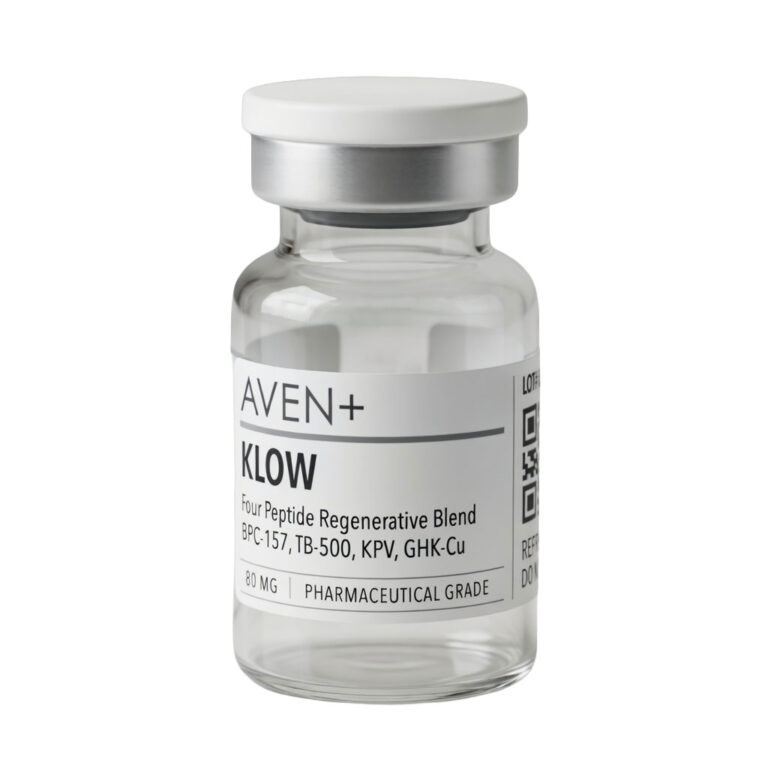
KLOW is a multi-peptide research blend formulated to combine the complementary biological activities of BPC-157, TB-500, KPV, and GHK-Cu. Together, these peptides are widely studied for their collective role in cellular repair, immune signaling modulation, extracellular matrix (ECM) regulation, and regenerative biochemistry.
1. Comprehensive Cellular Repair Support
KLOW is designed to address multiple layers of the repair process.
BPC-157 supports signaling involved in tissue protection and regeneration.
TB-500 influences cytoskeletal dynamics critical for cell migration and repair.
Together, they provide a robust model for studying coordinated cellular recovery under stress or injury conditions.
2. Regulation of Inflammation and Immune Signaling
A key benefit of KLOW is its role in immune modulation research.
KPV, a peptide derived from α-MSH, is studied for its ability to modulate NF-κB and cytokine signaling, pathways central to inflammatory responses.
This makes KLOW useful in experimental models examining inflammation balance, immune resilience, and recovery environments.
3. Supports Extracellular Matrix Remodeling
Healthy regeneration depends on a well-regulated extracellular matrix.
GHK-Cu influences collagen regulation, metalloprotein activity, and ECM turnover.
TB-500 supports actin polymerization and structural reorganization.
Together, these peptides make KLOW valuable in research focused on connective tissue dynamics and matrix remodeling.
4. Angiogenic and Growth Factor Signaling Research
BPC-157 is widely studied for its interaction with nitric oxide pathways and growth factor expression, both of which are essential for vascular support and nutrient delivery. In combination with the other peptides, KLOW allows researchers to study integrated angiogenic and regenerative signaling networks.
5. Redox Balance and Antioxidant Pathway Support
GHK-Cu plays a central role in copper-dependent redox regulation and supports enzymatic antioxidant systems. This function is critical in research models examining oxidative stress, cellular aging, and metabolic resilience.
6. Multi-Pathway Regenerative Synergy
One of KLOW’s primary advantages is its synergistic design. Each peptide targets a different but interconnected biological pathway—structural repair, immune modulation, oxidative balance, and signaling regulation—making KLOW an effective research tool for studying complex regenerative systems rather than isolated mechanisms.
7. Useful in Musculoskeletal and Connective Tissue Research
Due to its combined effects on cytoskeletal structure, ECM regulation, and cellular signaling, KLOW is frequently used in studies related to muscle, tendon, ligament, and soft tissue recovery models.
8. Valuable Tool in Advanced Peptide Research
KLOW serves as a model peptide blend for investigating:
Peptide–peptide interactions
Peptide–metal complexes
Coordinated regulation of inflammation and regeneration
Its formulation allows researchers to explore systems-level biological responses rather than single-target effects.
Summary
In research settings, KLOW is valued for its potential benefits related to cellular repair, inflammation modulation, extracellular matrix remodeling, oxidative balance, and regenerative signaling synergy. By combining BPC-157, TB-500, KPV, and GHK-Cu, KLOW provides a comprehensive platform for studying multi-pathway regeneration and immune-repair interactions.
Only logged in customers who have purchased this product may leave a review.
Lyophilized (freeze-dried) peptides should be stored in a refrigerator at 2–8°C (36–46°F). For long-term storage, they should be kept in a freezer at -20°C (-4°F) or below. Once reconstituted, peptides must be stored in a refrigerator at 2–8°C (36–46°F) and should not be left at room temperature for extended periods.
Since this is a blend, most people target a GHK-Cu dose and consider the rest a “bonus”. For this batch there is roughly 50mg of GHK-Cu per vial (along with roughly 10mg EACH of BPC-157, TB-500, and KPV). If you add 2mL of bacteriostatic water you’ll get a solution that is roughly 40mg/mL, such that every 0.1mL (10 units on an insulin syringe) is equal to roughly 2.5mg of GHK-Cu. Note that you may want to dilute it even more and adjust the math accordingly as GHK-Cu is known to cause a bit of a sting.
KLOW is a multi-peptide research blend formulated to combine the complementary biological activities of BPC-157, TB-500, KPV, and GHK-Cu. Together, these peptides are widely studied for their collective role in cellular repair, immune signaling modulation, extracellular matrix (ECM) regulation, and regenerative biochemistry.
1. Comprehensive Cellular Repair Support
KLOW is designed to address multiple layers of the repair process.
BPC-157 supports signaling involved in tissue protection and regeneration.
TB-500 influences cytoskeletal dynamics critical for cell migration and repair.
Together, they provide a robust model for studying coordinated cellular recovery under stress or injury conditions.
2. Regulation of Inflammation and Immune Signaling
A key benefit of KLOW is its role in immune modulation research.
KPV, a peptide derived from α-MSH, is studied for its ability to modulate NF-κB and cytokine signaling, pathways central to inflammatory responses.
This makes KLOW useful in experimental models examining inflammation balance, immune resilience, and recovery environments.
3. Supports Extracellular Matrix Remodeling
Healthy regeneration depends on a well-regulated extracellular matrix.
GHK-Cu influences collagen regulation, metalloprotein activity, and ECM turnover.
TB-500 supports actin polymerization and structural reorganization.
Together, these peptides make KLOW valuable in research focused on connective tissue dynamics and matrix remodeling.
4. Angiogenic and Growth Factor Signaling Research
BPC-157 is widely studied for its interaction with nitric oxide pathways and growth factor expression, both of which are essential for vascular support and nutrient delivery. In combination with the other peptides, KLOW allows researchers to study integrated angiogenic and regenerative signaling networks.
5. Redox Balance and Antioxidant Pathway Support
GHK-Cu plays a central role in copper-dependent redox regulation and supports enzymatic antioxidant systems. This function is critical in research models examining oxidative stress, cellular aging, and metabolic resilience.
6. Multi-Pathway Regenerative Synergy
One of KLOW’s primary advantages is its synergistic design. Each peptide targets a different but interconnected biological pathway—structural repair, immune modulation, oxidative balance, and signaling regulation—making KLOW an effective research tool for studying complex regenerative systems rather than isolated mechanisms.
7. Useful in Musculoskeletal and Connective Tissue Research
Due to its combined effects on cytoskeletal structure, ECM regulation, and cellular signaling, KLOW is frequently used in studies related to muscle, tendon, ligament, and soft tissue recovery models.
8. Valuable Tool in Advanced Peptide Research
KLOW serves as a model peptide blend for investigating:
Peptide–peptide interactions
Peptide–metal complexes
Coordinated regulation of inflammation and regeneration
Its formulation allows researchers to explore systems-level biological responses rather than single-target effects.
Summary
In research settings, KLOW is valued for its potential benefits related to cellular repair, inflammation modulation, extracellular matrix remodeling, oxidative balance, and regenerative signaling synergy. By combining BPC-157, TB-500, KPV, and GHK-Cu, KLOW provides a comprehensive platform for studying multi-pathway regeneration and immune-repair interactions.

You know those nights when you plan to read one article and somehow end up spending three hours researching something? That was me with KLOW. Started with copper peptides, then got into BPC-157 and TB-500. The combination is interesting from a research perspective. There’s definitely a lot to unpack here
Four different peptides in one blend? That’s what got my attention right away. I was reading about KPV and GHK-Cu separately when I stumbled across KLOW. Pretty neat combination, actually
Putting together a materials budget is never the fun part. I was comparing the single-vial and ten-vial options and liked having both quantities listed. Makes the numbers easier to sort out without a bunch of back-and-forth
Our research discussion started with whether it made more sense to study individual peptides or a combined formulation. KLOW brought up some interesting questions because each component is associated with different biological pathways. The blend might be useful for exploring interactions, although separating individual effects would take a carefully designed experiment. Quite the interesting setup
A nice-looking product page is one thing, but the actual testing data matters more to me. KLOW’s listing includes a dated purity report, average measured mass, and a lot reference, which are useful details for checking the product’s specifications. I’d still review the full report rather than judging quality from a percentage alone. No point cutting corners when research materials are involved
Straight to the lab report, mate. That’s always my first stop. The published purity result caught my eye, but I’d still verify the batch details. Better safe than sorry
Only logged in customers who have purchased this product may leave a review.
Lyophilized (freeze-dried) peptides should be stored in a refrigerator at 2–8°C (36–46°F). For long-term storage, they should be kept in a freezer at -20°C (-4°F) or below. Once reconstituted, peptides must be stored in a refrigerator at 2–8°C (36–46°F) and should not be left at room temperature for extended periods.
Since this is a blend, most people target a GHK-Cu dose and consider the rest a “bonus”. For this batch there is roughly 50mg of GHK-Cu per vial (along with roughly 10mg EACH of BPC-157, TB-500, and KPV). If you add 2mL of bacteriostatic water you’ll get a solution that is roughly 40mg/mL, such that every 0.1mL (10 units on an insulin syringe) is equal to roughly 2.5mg of GHK-Cu. Note that you may want to dilute it even more and adjust the math accordingly as GHK-Cu is known to cause a bit of a sting.

TrueNorthMax (verified owner) –
You know those nights when you plan to read one article and somehow end up spending three hours researching something? That was me with KLOW. Started with copper peptides, then got into BPC-157 and TB-500. The combination is interesting from a research perspective. There’s definitely a lot to unpack here
ChillDawson (verified owner) –
Four different peptides in one blend? That’s what got my attention right away. I was reading about KPV and GHK-Cu separately when I stumbled across KLOW. Pretty neat combination, actually
Maple Ryder (verified owner) –
Putting together a materials budget is never the fun part. I was comparing the single-vial and ten-vial options and liked having both quantities listed. Makes the numbers easier to sort out without a bunch of back-and-forth
EastCoast Ben (verified owner) –
Our research discussion started with whether it made more sense to study individual peptides or a combined formulation. KLOW brought up some interesting questions because each component is associated with different biological pathways. The blend might be useful for exploring interactions, although separating individual effects would take a carefully designed experiment. Quite the interesting setup
BCExplorer (verified owner) –
A nice-looking product page is one thing, but the actual testing data matters more to me. KLOW’s listing includes a dated purity report, average measured mass, and a lot reference, which are useful details for checking the product’s specifications. I’d still review the full report rather than judging quality from a percentage alone. No point cutting corners when research materials are involved
ArcticCole (verified owner) –
Straight to the lab report, mate. That’s always my first stop. The published purity result caught my eye, but I’d still verify the batch details. Better safe than sorry